The Complete SBTI Guide: All 27 Personality Types, the Algorithm Behind the Test, and What It Means for Dating
What is SBTI, what are the 27 personality types, and why does the result feel so accurate? This full guide breaks down the SBTI test, its algorithm, and what each type may look like in relationships.
What Is SBTI? One Sentence First
SBTI, short for Silly Big Personality Test, is a viral personality test that started as a playful spoof of MBTI and exploded online through self-deprecating humor, absurd labels, and highly shareable results.
It is not an upgraded version of MBTI, and it is not a tool created by any psychology institution. It is basically an internet product built by a Bilibili creator using AI and front-end tools - and it worked far better than anyone expected.
On April 9, 2026, the creator "蛆肉儿串儿" (later renamed "Q 肉儿串儿") posted the test online. The original idea was simply to persuade a friend who drank too much to stop drinking. Instead, it spread across Weibo, Xiaohongshu, WeChat, Douyin, and Bilibili almost overnight, and the original server reportedly crashed several times on day one. According to the narrative around the trend, more than 10 million people worldwide have already taken the SBTI test, and the hype is still going.
How Does the SBTI Test Work?
- Number of questions: 31
- Time to finish: around 3 to 5 minutes
- Answer format: A/B/C multiple choice
- Question style: a mix of ordinary personality questions and completely absurd ones, such as "What would you do if you were constipated on the toilet for 30 minutes?" or "This question has no question, just pick one"
Once you finish, the system gives you a type code + nickname + humorous interpretation + exclusive 3D avatar, in a format that looks very similar to MBTI, even though the content lives in a totally different universe.
The SBTI Algorithm: It Is Not Random, It Is Math
A lot of people assume SBTI is just randomly assigning funny results. But it actually has a full calculation logic behind it.
15 Dimensions x 5 Models
SBTI measures your tendencies across 15 psychological dimensions, grouped into 5 model categories:
| Model | What it covers |
|---|---|
| Self | Confidence, self-awareness, self-discipline |
| Emotion | Sense of security, emotional stability, emotional regulation |
| Attitude | Rules, values, and risk preference |
| Action | Execution, decision style, goal orientation |
| Social | Social initiative, empathy, perception of others |
Your answers to the 31 questions are mapped into a 15-digit feature vector.
Matching by Manhattan Distance
Once the system gets your feature vector, it compares it against the preset vectors of 27 personality types using the Manhattan Distance algorithm. Whichever type has the shortest distance becomes your result.
That is also why changing just one answer can sometimes change your outcome completely - the matching is fairly sensitive.
Two Special Types
- DRUNK: a hidden result that only appears if the test identifies heavy drinking behavior
- HHHH: a fallback result for people whose pattern is too unusual to fit any standard type cleanly
A Complete Guide to All 27 SBTI Personality Types
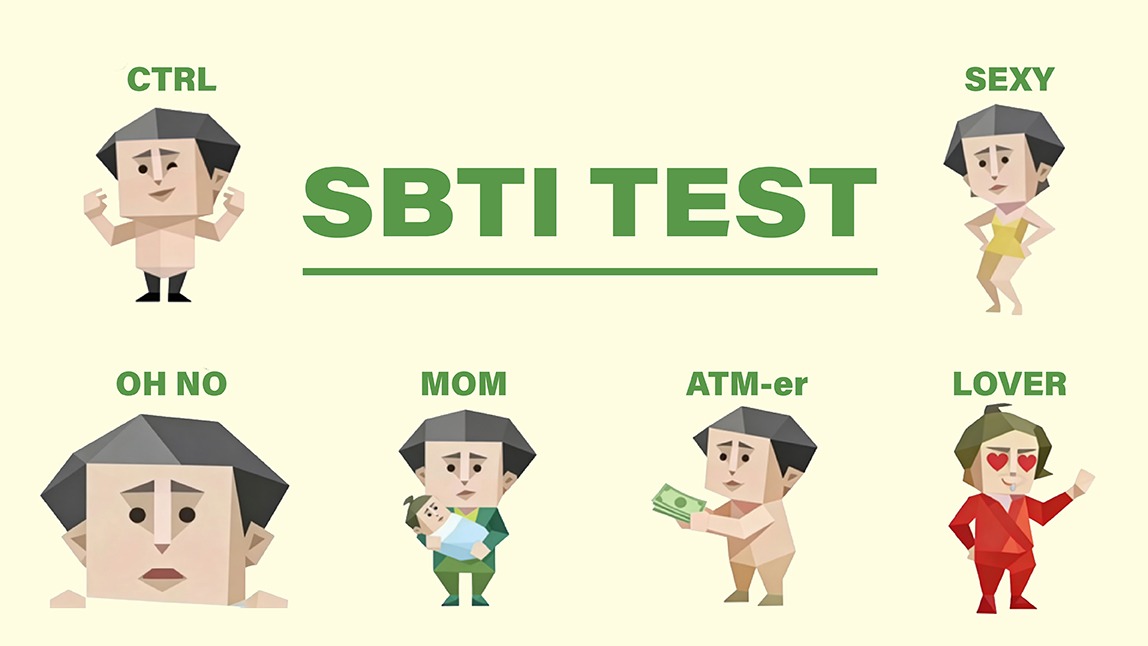
The image below shows the full grouped chart of all 27 SBTI personality types, including each character avatar and label:
Below, the main types are explained by trait group:
The Dominant Control Types
This group shares two major traits: strong execution and a strong need for control. In a crowd, they are often the ones calling the shots.
CTRL (The Controller)
- Catchphrase: I'll handle it
- Dating pattern: Controls the pace of the relationship, takes the initiative, sets the plans, and even starts the negotiation after a fight. If the other person is too passive, they get bored
- Dating keyword: Strong sense of control, but still wants recognition
BOSS (The Boss)
- Catchphrase: Give me the wheel, I'll drive
- Dating pattern: Feels deeply responsible once in a relationship and often arranges everything for the other person, but sometimes forgets to ask what they actually want
- Dating keyword: Highly capable, but communication can feel a little overbearing
GOGO (The Action Type)
- Catchphrase: If we're doing it, let's do it now
- Dating pattern: High energy, fast-moving, likes to show love through action, rarely sits still and waits
- Dating keyword: Proactive in pursuit, but can overlook the other person's pace
The Social Magnet Types
This group stands out for high interpersonal appeal and strong social energy. They are often the center of attention in a group.
SEXY (The Charmer)
- Catchphrase: Just wait for my underdog comeback
- Dating pattern: Passionate about love, naturally magnetic, easy to notice, but sometimes enjoys being pursued more than doing the pursuing
- Dating keyword: Highly attractive, but still needs stability
LOVE-R (The Romantic)
- Catchphrase: Love is everything
- Dating pattern: Cares deeply about rituals, anniversaries, surprises, and verbal affection, but can sometimes set expectations too high
- Dating keyword: Romantic idealist, emotionally invested
OJBK
- Dating pattern: Socially smooth and easy with many kinds of people, but emotional depth in relationships is a separate question
- Dating keyword: Likable and easygoing, but sometimes too easygoing in love
The Emotional Support Types
This group is defined by high empathy and strong emotional giving or emotional need.
MUM (The Caregiver)
- Catchphrase: Let me take care of you
- Dating pattern: Naturally nurturing, remembers all the small details, and worries about the other person's needs, but can slowly wear themselves out in relationships
- Dating keyword: Giving personality, often forgets to ask for anything back
THAN-K (The Grateful One)
- Catchphrase: Thank goodness I met you
- Dating pattern: Emotionally resilient, good at repairing tension after conflict, and not very prone to holding grudges
- Dating keyword: Strong resilience, relationship maintainer
OH-NO (The Oh-No Type)
- Catchphrase: Oh no! How did I end up with this type?!
- Dating pattern: Highly sensitive to uncertainty and change, needs a strong sense of stability and predictability in love
- Dating keyword: Needs security, emotionally sensitive
The Self-Mocking Burnout Types
This is one of the most widely shared SBTI groups, and one of the most relatable for young people online.
DEAD
- Catchphrase: Fully checked out, seen through everything
- Dating pattern: Looks emotionally flat on the outside, but has usually analyzed the relationship in detail on the inside and just cannot be bothered to explain it
- Dating keyword: Rich inner world, minimal outward expression
ZZZZ (The Playing Dead Type)
- Catchphrase: Don't want to work, don't want to date, don't want to move
- Dating pattern: It is not that they never want love. They just do not have energy for exhausting relationships. With the right person, they suddenly come back to life
- Dating keyword: Low-consumption type, needs the other person to draw them out
MALO
- Catchphrase: The classic worker bee, quietly grinding away
- Dating pattern: Steady and hardworking, rarely confesses first, but becomes extremely serious once the relationship is defined
- Dating keyword: Stable and dependable, not expressive but reliable in action
DRUNK
- Note: a special trigger type that only appears in heavy drinkers
- Dating pattern: Emotionally intense, prone to impulsive confessions, and also prone to regretting them later
- Dating keyword: High passion, low stability
The Contradictory Complex Types
These are the hardest types to judge, because there is often a clear gap between how they act and what is happening inside.
ATM-er
- Catchphrase: Do I really look that rich to you?
- Dating pattern: Easily ends up carrying all the financial and emotional cost in a relationship, then eventually asks themselves why
- Dating keyword: Over-giving, weak boundaries
FAKE
- Dating pattern: Extremely polished social mask, very hard to truly read, often keeps a certain emotional distance even in love
- Dating keyword: Defensive, very high trust threshold
POOR
- Catchphrase: The type Su Xing reportedly got
- Dating pattern: Feels scarcity very strongly around time, money, and emotional resources, and can become highly sensitive to whether effort is balanced
- Dating keyword: Needs fairness, sensitive to imbalance
JOKE-R (The Joker)
- Catchphrase: Haha, I'm the clown
- Dating pattern: Uses humor to deflect emotions, but can also hide behind jokes when a serious conversation is needed
- Dating keyword: Very entertaining, but emotionally shallow on the surface
Dior-s
- Dating pattern: Low self-evaluation, tends to idealize the other person and underestimate themselves, and can become insecure very quickly once attached
- Dating keyword: Clear people-pleasing tendency
IMSB
- A rarer type that usually needs to be interpreted alongside the full test result
HHHH
- A fallback type that appears when your personality combination is too unusual to classify simply
- Dating pattern: Hard to categorize, possibly the most singular type of all
Why Does SBTI Feel "Scarily Accurate"?
There is a well-known psychology concept behind this: the Barnum Effect. People tend to feel that broad, general personality descriptions are highly specific to them, even when those descriptions could apply to a great many people.
But SBTI feels "accurate" for a few additional reasons too:
1. It Describes Your Most Visible Traits
"You come across as cold," or "You are the center of the room" - these are not abstract theoretical judgments. They are based on the kind of impression other people form of you, and that is exactly the angle many people already care about most.
2. Its Labels Are Easy to Project Yourself Onto
"DEAD" and "MALO" are not just personality words. They are internet mood words for an entire generation. The second you see them, they feel less like a diagnosis and more like a compressed version of a lived emotional state.
3. It Caught the Right Emotional Moment
Burnout, pressure, anxiety, emotional exhaustion - many young people are already living in that atmosphere. A test that lets you laugh at yourself is often more immediately relatable than one that asks for a serious, analytical self-assessment.
SBTI vs MBTI: What Is the Real Difference?
| Dimension | MBTI | SBTI |
|---|---|---|
| Origin | Jungian psychology, academic background | A Bilibili creator, AI-generated |
| Goal | Cognitive preferences, decision style, personality structure | Entertainment, self-mockery, social sharing |
| Question count | 93 questions (standard version) | 31 questions |
| Result types | 16 | 27 |
| Scientific basis | Has psychological roots, though still debated | Explicitly entertainment-first, not scientific |
| How it spreads | Through the test itself and psychology communities | Through social media memes and screenshots |
| Best use cases | Self-understanding, career planning, teamwork | Icebreakers, social fun, playful comparison |
One-sentence summary: MBTI is your cognitive coordinate system. SBTI is your social label. One explains structure. The other explains how something spreads.
What Can SBTI Actually Do in Dating?
SBTI can be used in dating - but how you use it matters.
What It Is Good For: Fast Impressions and Easy Icebreakers
- "What type did you get?" feels fresher than "What's your zodiac sign?"
- A result can quickly reveal someone's social vibe
- Comparing two results naturally gives people something to talk about
Typical Relationship Chemistry Between Different Types:
CTRL x LOVE-R: One controls the pace, the other loves romance. The early-stage chemistry can feel extremely strong. But over time, CTRL may feel pressured by LOVE-R's emotional expectations, while LOVE-R may feel CTRL is too rational.
DEAD x SEXY: One is calm and restrained, the other is highly magnetic and outward. The tension is that SEXY wants visible attention, while DEAD rarely gives it directly. But that very scarcity can make SEXY feel even more drawn in.
MALO x BOSS: One quietly gives, the other sets the direction. If BOSS fails to notice MALO's effort, the relationship can slowly drain MALO emotionally.
ATM-er x FAKE: A high-risk pairing. ATM-er tends to over-give, while FAKE is slow to open up. Over time, this can easily become a situation where one side is exhausted and the other still cannot truly respond.
What It Is Not Good For: Judging Deep Relationship Dynamics
What actually determines the direction of a relationship is not your "social label." It is your deeper pattern inside intimacy:
- Do you push relationships forward, or do you tend to wait?
- Do you need frequent reassurance, or more personal space?
- During conflict, do you solve the issue first or handle the feelings first?
- Do you care more about practical fit, or emotional chemistry?
SBTI cannot really answer those questions for you.
From a Viral SBTI Trend to a Real Understanding of Your Dating Pattern
The popularity of SBTI says something important: this generation wants to feel understood, but does not want to do it in a way that feels heavy or overly serious.
It is a great way to open a conversation about self-discovery. But it is only an entry point, not the answer itself.
If you want to understand who you really are in intimate relationships -
- Are you more leading or more following?
- More attachment-driven or more independent?
- More practical in love, or more passion-driven?
- More likely to deeply commit, or to keep your options open?
Those are the dimensions that shape the deeper logic of how you love and how you get hurt.
👉 Want to know your real relationship pattern in love? Take the Love Type 16 test now and use a framework designed specifically for intimacy to find your romantic coordinates.
Frequently Asked Questions FAQ
Q: Is the SBTI test free? A: Yes. The SBTI test is free, does not require registration, and usually takes about 3 to 5 minutes. The original site is sometimes unstable, and multiple mirror versions have also circulated.
Q: Are SBTI results actually accurate? A: SBTI does not present itself as scientifically accurate. The reason many people still resonate with the result is more about internet language, emotional projection, and the Barnum Effect.
Q: Can I use SBTI together with MBTI? A: Yes. The official SBTI site reportedly even offers an SBTI x MBTI cross-analysis feature, where you can pick your MBTI type after the test and get a combined interpretation card.
Q: What does it mean if I get DEAD? A: DEAD is one of the most famous SBTI results. It basically represents a "fully checked out, seen-it-all" state. It is an internet joke label, not a clinical or negative judgment.
Q: How many possible SBTI results are there? A: There are 27 in total: 25 standard types and 2 special types. DRUNK requires specific answers to trigger, while HHHH works as a catch-all result for unusual patterns.
Q: Is SBTI useful for love compatibility? A: It is useful for icebreakers and getting a quick feel for someone's social vibe, but it is not a strong tool for judging deeper relationship dynamics. If you want to understand how people actually function in intimacy, a test designed specifically for relationships will be more helpful.